| ||
| Home | Forum | Catalog | View cart | Contact |
No, the SQM-LE is not weatherproof. For permanent mounting outside, it should be mounted in a weatherproof housing.
We sell such a housing here.
For people using the unit only during telescope observations, the meter can be stowed away with the telescope.
Here are some sources for plastic domes:Yes, the heat generated inside the SQM-LE by the internal web server is high enough get rid of dew. When used with this housing, no dew was ever seen inside the unit. In fact, drops of rain on the glass cover evaporated after a few hours.
It may be important to allow moisture to escape, that is why we have an air hole on the bottom of our housing.
As far as frost goes, the unit is too warm to allow that. If the unit is un-powered then moisture will likely build up. It is probably best to always keep the unit powered.
A PoE system can be used to transmit "Power Over the Ethernet" cable to the SQM-LE. A PoE system consists of two units:
The PoE Injector would be located near the router, and the PoE splitter is located near the SQM-LE.
The PoE soution is very handy if you do not have an electrical outlet near the SQM-LE. You can just run the Ethernet cable to the PoE Splitter then short wires come from the splitter to the SQM-LE.
We have tested these models successfully with the SQM-LE:If you already have a PoE system (with injector), then you just need a PoE splitter that puts out 5V for the SQM-LE.
The combined spectral response compared to other standards is shown in this Night Sky Photometry with Sky Quality Meter report in Fig 12, on page 6.
The northern Milky Way contributes about 0.10 mpsas under 21.5 mpsas (moonless) skies.
The southern Milky Way might be as big an effect as 0.85 mpsas where it goes near-overhead.
For more information, see Surface Photometries of the Milky Way (Schlosser+ 1997)
The SQM's readings are assuming 'best transparency'.
You can get an updated definition of the transparency in your area from:
Also, frequently local weather stations can provide "visibility" and "relative humidity" numbers which could potentially be used as surrogates for actual transparency measurements (which aren't possible with a handheld meter).
Magnitudes are a measurement of an objects brightness, for example a star that is 6th magnitude is brighter than a star that is 11th magnitude.
The term arcsecond comes from an arc being divided up into seconds. There are 360 degrees in an circle, and each degree is divided into 60 minutes, and each minute is divided into 60 seconds. A square arc second has an angular area of one second by one second.
The term magnitudes per square arc second means that the brightness in magnitudes is spread out over an square arcsecond of the sky. If the SQM provides a reading of 20.00, that would be like saying that a light of a 20th magnitude star brightness was spread over one square arcsecond of the sky.
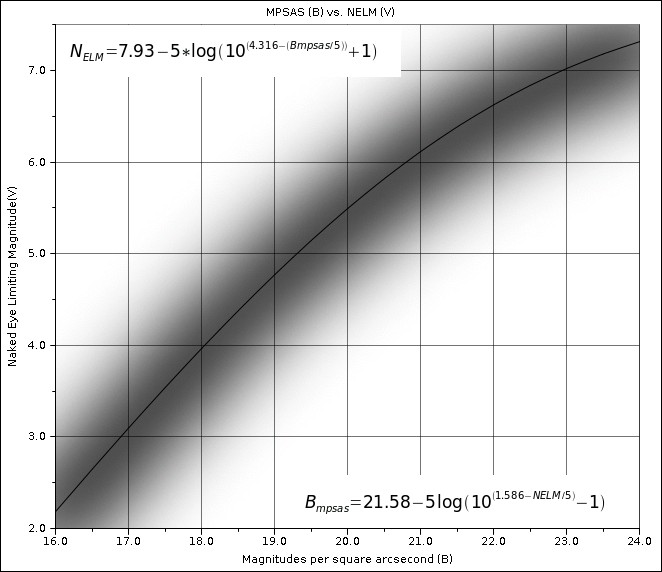
Quite often astronomers will refer to a sky being a "6th magnitude sky", in that case you can see 6th magnitude stars and nothing dimmer like 11th magnitude stars. The term "6th magnitude skies" is very subjective to a persons ability to see in the night, for example I might say "6th magnitude skies" but a young child with better night vision might say "7th magnitude skies". You can use this nifty calculator created by SQM user K. Fisher to do that conversion, or this chart.
The "magnitudes per square arcsecond" numbers are commonly used in astronomy to measure sky brightness, below is a link to such a comparison. See the third table in section 10 for a good chart showing how these numbers in magnitudes per square arcsecond relate to natural situations:
www.stjarnhimlen.se/comp/radfaq.htmlEach magnitude lower (numerically) means just over 2.5 times as much more light is coming from a given patch of sky. A change of 5 mags/sq arcsec means the sky is 100x brighter.
Also, a reading of greater than 22.0 is unlikely to be recorded and the darkest we've personally experienced is 21.80.
The value produced by the sensor in the SQM is affected by temperature. There is a temperature sensor in the SQM that compensates for this effect. However, when the SQM is first powered up, the light sensor is colder than when the power has been on for a few seconds. Depending on the ambient temperature this will result in the first reading being slightly higher than subsequent readings.
For the most accurate results, it is best to take many readings and disregard the very first reading.
The temperature sensor and light sensor are separated on the circuit board. Waiting for a while will allow a changing temperature to migrate so that both sensors are at the same temperature.
This issue is due to the transient response of the TSL237 which briefly changes its light-to-frequency characteristic when it is warmed by applied power. Ironically, the normally very sensible practice of leaving it out at the environmental temperature probably makes it more significant.
There is no specific limit on the range of the SQM because the calibration step fixes the maximum and minimum frequencies to intermediate values. For normal night-time viewing, the meter should accurately read from about 16 to 23 mpsas, but is it has a range from about 7 (brightest) to 23 (darkest).
Each sensor is slightly different. The calibration uses the dark period of the sensor compared to a frequency at a specified light level.
The meter sets a bright limit of 400kHz which is the specification for light saturation of the TSL237S sensor. When the sensor frequency reaches this value, the output is set to 0 mpsas. The only thing that will extend sensitivity in bright settings is to limit the amount of light received with an optical filter. Filters can be fitted over the meter manually or with the help of an adaptor like these.
The internal limit for the dark period is 60 seconds which works out to about 26mpsas for most sensors.
Some testing can be done using the UDM software with simulation mode on a connected meter.
No. Lux (lx) and foot candles (fc) are a measure of "Illumination" (light hitting a surface). Meters that measure this usually have a white surface were light hits and is measured by a sensor inside which is calibrated to Lux or fc.
The SQM measures "Luminance", the light given off by a surface. In the case of night sky viewing for astronomy, it is the light given from the night sky that you would see with your eye. Luminance meters see the light as your eye would (from a point outwards in a cone) and only a small sensor area is used. The SQM produces a reading of magnitudes per square arcsecond which can be converted to other Luminance values like "candela per square meter". We have such a converter on our website here.
When determining brightness differences with the SQM, you can convert the reading to cd/m^2 then get the ratio between your various readings by division. Using this method, you should be able to say that "light fixture A is X times brighter than light fixture B".
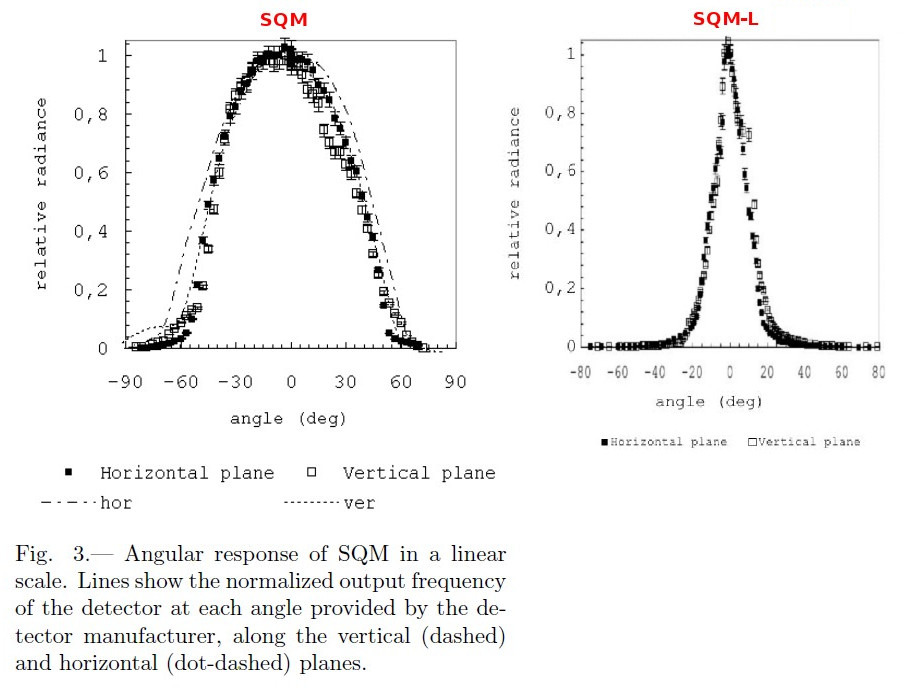
For the Sky Quality Meters, the un-diffused value of light is received in a cone shape with the response shown here.
For purposes of light sensor compensation, there is a temperature sensor located inside the meter.
This internal temperature reading is available to the user. The value is not the ambient or outdoor temperature.
The meter is calibrated to be pointed upwards (Zenith) when taking readings.
Pointing in directions that see obstructions or the ground will result in inaccurate readings.
Adding a shroud is possible, but it will likely cover the field of view, then the reading will become darker by a fixed amount. You can determine that darkening amount by taking readings with/without the shroud in an evenly lit dark open sky. Then you would subtract your shrouded readings by that measured difference.
See FOV comparison chart for as reference of what the field view is for your meter.